
Weighing up business schools’ work on sustainability
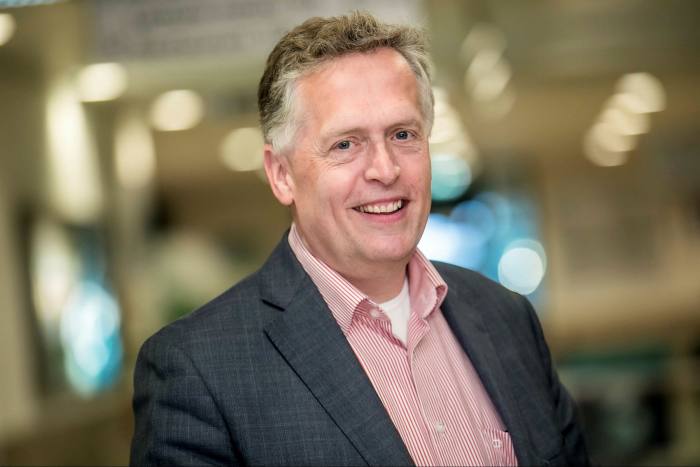
Wilfred Mijnhardt has a trouble. Europe is household to some of the world’s oldest and most prestigious organization colleges, and it has been at the forefront of much of the worldwide innovation in training and exploration on sustainability.
But when he analyses institutions’ performance based on their posture in general rankings, let by itself their educational exploration output, he finds a sizeable mismatch with individuals carrying out most to foster dependable organization instruction.
Mijnhardt, policy director at Rotterdam College of Administration at Erasmus University, is a single of a rising variety of specialists checking out strategies to greater capture such tendencies. It is also a question on which the FT is reflecting and canvassing views in conjunction with educational and sustainability groups. Notably, Mijnhardt has mapped the hyperlinks between the organization schools’ exploration output and the UN’s sustainable improvement ambitions (SDGs).
“Business colleges are lagging guiding [other disciplines],” he states. “They assume that if they make a number of publications that depend for rankings and accreditation applications, they are carrying out exploration. But this world is much bigger than that and educational culture is so much a lot more.”
Mijnhardt analyzed content on SDGs published by organization faculty workers considering that 2015 that had been released in the FT50 listing of influential journals. He located that the major establishments are significantly targeted on the subject, with strong output in Europe from colleges at the universities of Glasgow, Leeds and St Gallen, for occasion.
But there are major gaps, with climate transform-related subject areas explored considerably fewer in these content than themes such as poverty reduction and innovation. Some of the content with the finest SDG relevance and influence are released in a lot more obscure and fewer effectively-regarded journals.
Mijnhardt indicates organization colleges have moved a lot more little by little than other educational departments to do the job on a lot more interdisciplinary, collaborative and socially pertinent themes. One purpose is they are fewer reliant on — and accountable to — external exploration funders which are significantly targeted on the priorities of the SDGs. As an alternative, their exploration tends to be indirectly subsidised by high tuition fees or donations.
Jerry Davis, affiliate dean for organization and influence at Ross College of Enterprise at the University of Michigan, is a lot more nuanced. “Business colleges ironically are a single of the past preserves where you are totally free to abide by your intellect where it goes, for the reason that you are not reliant on government or company funding,” he states. “We have likely a lot more educational liberty to uncover issues.”
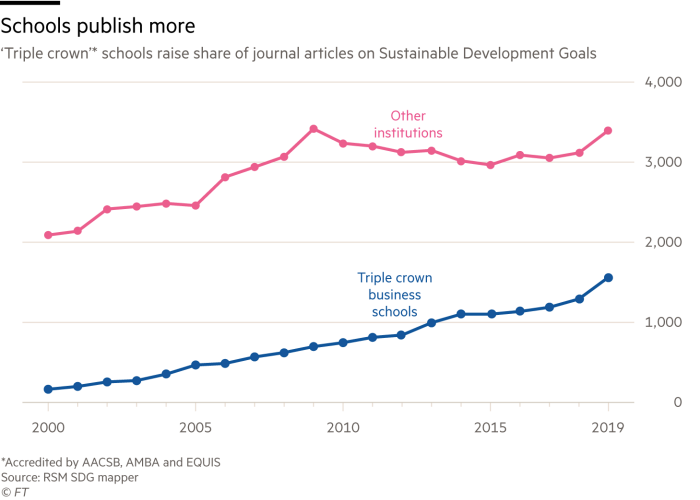
Educational facilities with the prestigious ‘Triple crown’ of accreditation from the AACSB, AMBA and EQUIS are publishing a lot more content related to UN sustainable improvement ambitions in the FT50 listing of influential educational journals used in organization instruction rankings
However in exercise, as a founding member of Responsible Research for Enterprise & Administration (RRBM), a community of teachers pushing for “credible and helpful research”, he states a lot more requirements to be performed to reorient his peers’ functions to initiatives and publications that offer better societal influence.
One critique of present organization faculty rankings, which includes the FT’s, is that their calculations do not concentrate so much on these subject areas. As an alternative, they draw on information details such as salaries that do not reflect — and may well even likely undermine — rising need by college students, college and employers for a better emphasis on such social intent, which includes in their educational output.
But there is a a lot more fundamental situation for individuals keen to convey about transform: the deficiency of consensus on strategies to meaningfully assess such functions. Other assessments targeted on the SDGs rely heavily on subjective, qualitative judgments by college students and college. They are limited by reference to their possess encounters and establishments, devoid of an external benchmark.
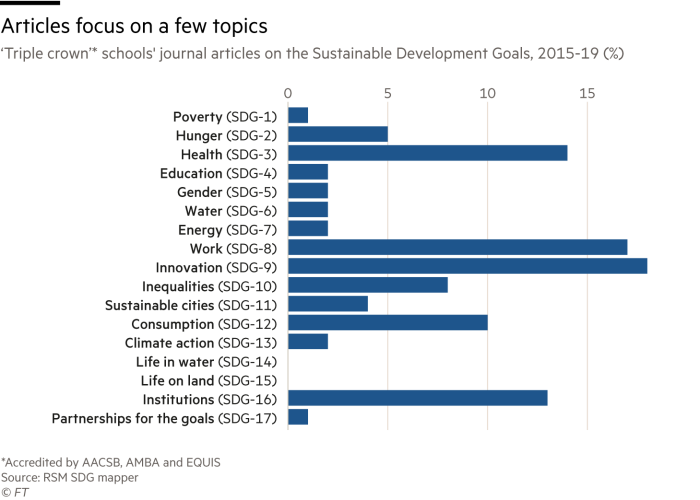
Enterprise faculty teachers have a tendency to concentrate heavily on certain SDGs, most notably health, innovation, do the job, consumption and establishments, while topics such as the earth, poverty, instruction and gender acquire reasonably very little awareness
It is particularly challenging to consider the influence of “environmental, social and governance” elements in classroom training or alumni careers. Even in educational exploration, extensive scrutinised by means of “bibliometrics” checking out the information all-around released exploration, there is very little settlement on which measures to use.
Concentrating on the information of content that refer to the SDGs presents a proxy on the extent of activity all-around these issues. But it provides only a crude yardstick for the originality, benefit or applicability of the fundamental exploration.
Specialists such as Amanda Goodall, affiliate professor at The Enterprise College, Metropolis, University of London (formerly Cass), advocate growing the range of publications that are taken into account beyond individuals in the greatly recognised and prestigious FT50, to include a lot more interdisciplinary and professional journals. That would enable for a wider selection of themes but could also dilute the perceived educational high-quality.
Applying citations by other teachers of content would enable counter criticism by incorporating a peer evaluation of the high-quality of any publication. But it does not give an indicator of the influence beyond college walls: the extent to which exploration is examine, shared and implemented by firms, governments and other organisations. References to content on social media provide some external validation of desire but also a high degree of “noise”. A greater approach might be consider into account references to educational exploration in the media, professional weblogs and policy papers.
These are some of the issues on which the FT, RRBM, the UN’s Principles of Responsible Administration community and many others, which includes the Globally Responsible Management Initiative of organization colleges, are seeking views.
Irrespective of the difficulties, Prof Davis is optimistic about academia’s ability to develop alternate measurements, in section for the reason that of fresh new desire in societal influence within instruction and beyond. “Millennials have a fairly strong feeling of social justice and the influence of the do the job they do. I’m incredibly enthused by the coming generations,” he states.
Remember to share your views on how to greater measure educational exploration at ft.com/ft50


