
Learning to take leading roles in the arts
For 13 yrs, Joachim Thibblin was in a career he was not formally educated for. The artistic director at Svenska Teatern, Finland’s 155-yr-aged national theatre for Swedish-language performances, started managing theatres in 2006. Before that, he had been an actor and his only encounter as a student was at drama school.
“Throughout my profession I have been on the lookout for different educational options to assist me in this [management] purpose, but mainly it has been learning by accomplishing or buying up guidance as a result of networking,” he claims.
Then, in 2019, he was acknowledged on to the Small business of Culture, an eight-month class co-produced by the government training teams at Finland’s Aalto University, BI Norwegian Enterprise College and the Nationalmuseum in Stockholm.
Considerably of the programme is taught in team conversations, similar to MBA lessons, with modules in strategic associations and management, as properly 1-on-1 coaching. College students vacation to lessons at campuses in Copenhagen, Helsinki and Oslo. The component-time structure was created for experts functioning for arts and cultural organisations across the Nordic and Baltic countries, so that they can practise what they have learnt between seminar periods.
The programme could not have arrive at a superior time for Thibblin, offered the will need for disaster management all through the pandemic, which pressured his theatre to near for extended durations about the previous two many years. “It enabled me to acquire myself to the future amount as a chief,” he suggests. “Crisis management was a thing incredibly new to me, but I was mastering how to produce myself as a chief by way of psychological capabilities, how to have an understanding of how I was perceived by colleagues and how to mentor them better.”
Designers of MBA programmes have long noticed the arts as a useful training device — for illustration, making use of efficiency lessons to improve executives’ conversation techniques — but business universities have struggled to catch the attention of senior leaders from artistic institutions as college students. The explanation is often that arts managers experience their difficulties are different to these faced by the expense bankers and administration consultants who are the mainstay of MBA cohorts.
Some educational institutions have built efforts to provide arts and organization students alongside one another. In London, Imperial Higher education Enterprise School’s Entrepreneurial Journey programme matches MBA learners with style and design students from the Royal Higher education of Artwork to variety start off-up teams with expertise in finance and product development.
“Diversity is vital to us and this delivers a cognitive range to these groups with the distinct techniques of designers and MBA students,” says Markus Perkmann, professor of innovation and entrepreneurship at Imperial.
“We do have folks from the arts on our MBA programme and it can make very good perception for these people today, whose prior education may perhaps have been an arts degree. However, there are not lots of who arrive from this background.”
Management courses developed for persons in the arts, these types of as that created by Aalto and BI, are springing up at other European business enterprise schools. This partly demonstrates the breadth of arts schooling about the continent, normally in near proximity to the MBA suppliers.
Geneva Enterprise School has launched an MBA programme in world wide good art administration, aimed at building a new technology of collectors, sellers and artists. The 18-month training course, announced in May possibly, is created to appeal to people with possibly an artistic or a business background, in accordance to Sixtine Crutchfield-Tripet, programme supervisor. “Artists who have learnt the craft can now learn the trade,” she claims. “Finance administrators and lawyers will uncover a specialisation in their personal industries that they hardly ever suspected.”
In July, EMLyon enterprise faculty in France signed an settlement with close by Saint-Etienne Greater Faculty of Artwork and Style to create joint programmes. Among the the first is an exchange amongst design and small business students.
“There are some wonderful artists, but they do not know how to promote what they produce,” states Annabel-Mauve Bonnefous, dean of programmes at EMLyon. “Also, company college students can master from style and design principles to see how they can develop corporate methods.”
Enterprise faculty programmes aimed at men and women in the arts are an acknowledgment that they have particular requires in terms of administration training that set them apart from typical MBA candidates.
An early entrant to this sector was ESCP company faculty, which launched its professional masters in administration of cultural and creative activities 15 years ago, in partnership with Ca’ Foscari College of Venice. The entire-time programme operates from September to the end of March, after which college students full an internship and a specialist thesis. In between the two institutions, 650 people today have graduated from the course.
Carole Bonnier, an ESCP professor who will take above as programme director in January, states: “The key problem for our college students is to fully grasp the complexity of an artist’s persona to handle with no killing creativeness.”
Helen Sildna, who founded the agency Shiftworks to market the arts in her homeland, Estonia, and produced Tallinn Songs Week, is a further graduate of the Organization of Lifestyle programme run by the Nordic enterprise schools. Considering that her only formal diploma was in English language and literature from Tallinn University, Sildna decided she needed a organization education and learning qualification to assistance her transfer into entrepreneurship. “As a founder, it is taken for granted that you understand by executing but, at a specific level, I realised that I needed to be superior geared up,” she suggests.
Sildna bought as far as a pre-assembly for a cohort beginning an MBA at Estonia Enterprise University, but rejected the strategy since there were not ample people today from her sector. “I comprehend that I was observed as an attractive addition to the team,” she states. “But, when I observed the team, I just felt that the other users would be having this kind of considerably different experiences to me that I would not reward sufficient from being all around them.”
Even so, the Enterprise of Society programme offered the diversity that Sildna identified makes MBA class conversations about leadership fruitful. Pupils represented organisations that different from publicly funded venues to imaginative start-ups like her have, she suggests.
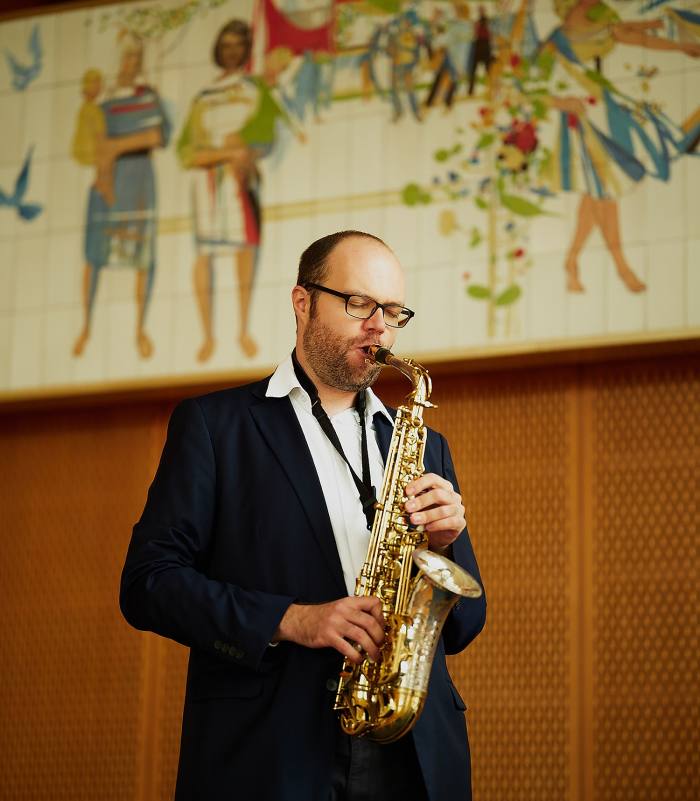
Some small business university professors have also found the training gains of channelling their interior artist. Hannes Gurzki is government training programme director at ESMT Berlin and a saxophonist, with a diploma from the UK’s Connected Board of the Royal Schools of New music. He combined the two disciplines by introducing jam periods for the MBA intakes.
He is joined in the classroom by other musicians, actively playing items in distinct kinds to illustrate how groups can function together. Pupils get involved as a result of clapping the rhythms and other participation.
“We use jazz as a metaphor for leadership since it is about learning to hear to one particular an additional,” Gurzki claims. “It is also fun. Individuals do not anticipate this to take place in a enterprise college so it permits them to stage out of their convenience zone and into a discovering zone.”


