
In times of crisis, we need to be more resilient
In 2016, Roger Martin guess his pal Jonathan Haidt, the social psychologist, $10,000 that Donald Trump would gain the presidential election. He will make distinct he did not vote for the Republican applicant, “but I am a system male and I believed the system of Hillary [Clinton] was awful. And the system of Donald Trump was brilliant”.
Four many years on, the management thinker — who was born in rural Canada, but now lives in south Florida — has an even larger guess on November’s poll: that whoever wins will enact Prof Martin’s agenda to “save American democratic capitalism” and change the US absent from what he sees as its harming obsession with ever larger performance.
He concedes it is far more probable that the progressive wing of the Democratic party would consider up his strategies than a second-phrase President Trump would. But he sounds as sceptical about Joe Biden’s approach as he was about Mrs Clinton’s. “I’m not incredibly approving of the Biden system, for what it is truly worth. But we shall see.”
The coronavirus pandemic has specified an further impulse to Prof Martin’s argument, outlined in his new reserve When Much more Is Not Better, that performance desires to be balanced by resilience.
“During occasions of tumult, I imagine folks are open to seeking and accomplishing different items,” he says in a video job interview. “The notion of resilience [has] received to have far more credibility now than it experienced a calendar year ago, since we actually received strike tricky by not staying resilient.”
Prof Martin, sixty four, has the balding pate and swift halt-get started shipping of a cartoon brainbox. His new reserve commences with a extensive, occasionally fairly theoretical, comparison of Gaussian (bell curve) and Pareto (“power law”) distributions. It reveals how makes an attempt to take care of the economy as a “perfectible machine” somewhat than a “complex adaptive system” have, above time, skewed economies in direction of monopolies, monocultures and self-perpetuating prosperity.
But above a extensive educational occupation, at Harvard Business University and then as dean of Toronto’s Rotman University of Management involving 1998 and 2013, Prof Martin has experimented with to stay rooted in the pragmatic realities of business enterprise and instruction. His strategies attract, for case in point, on his work as a expert, as a member of the board of the Good Jobs Institute, which aims to make superior jobs, especially in retailing, and as director, until eventually final calendar year, of the Martin Prosperity Institute, a Rotman imagine-tank.
The Institute ran a 6-calendar year challenge, setting up ahead of President Trump’s election, interviewing ordinary People about their expertise of democratic capitalism. It identified they have been disillusioned that the outdated formulation for financial accomplishment was not operating for them and that they have been disengaged from politics.

In looking for alternatives to that collapse in prosperity and confidence, Prof Martin deliberately looked for “do-able” strategies that experienced by now been tested, from Aristotle’s pursuit of a balanced and virtuous “golden mean” involving opposing vices, to the EU’s approach to tackling dominant engineering companies.
“People just you should not like to be the 1st to try some thing and be experimental,” he says. He also proposes setting up with modest techniques. For occasion, as citizens, he says we need to change some of our purchasing absent from prospective monopolists these kinds of as Amazon to regional shops, to counter the countrywide tendency in direction of Pareto results, where the significant just get larger. “If you place the load on any individual to consider significant, bold, scary techniques, you know, fantastic luck to you there. They’re just not likely to do it.”
Even so, he concedes that to change economies absent from the patterns of performance will need collective action.
The environmental disaster is making some shared momentum in direction of far more resilient economies. It is the most evident case in point of how today’s business enterprise graduates, who want to work only for companies with a sustainability agenda, differ from business enterprise learners in the late nineties, whose response to environmental issues was “Yeah, whatever”.
The human instinct to search for a easy resolution — based on a single, measurable target, these kinds of as the distinctive pursuit of shareholder price — will be tricky to override. Prof Martin blames business enterprise colleges for encouraging an performance-based approach, based on an “analytical, instrument-based, doctrinaire” curriculum. They are “spewing out folks who consider that information analytics is a resolution to all kinds of problems”.
Is Prof Martin applying the reserve to atone for the function consultants and management professors like him have played in the disaster of democratic capitalism? Unsurprisingly, he rejects the notion.
He details, for occasion, to his work advising business enterprise leaders who shunned reductionist performance programmes, these kinds of as AG Lafley, Procter & Gamble’s former main government, Jim Hackett, outgoing main government of Ford, and Jorgen Vig Knudstorp, former head of Lego. “I you should not do expense reduction studies for companies,” Prof Martin says. “I assist them determine out how to make terrific items or expert services and have workforce that they take care of with respect.”
He also details out that he has always looked for “integrative thinkers”, who recognise that the planet is elaborate and not topic to easy alternatives. Prof Martin acknowledges that only a minority of folks approach troubles in this way. But he offers a powerful recommendation to those who try to pressure business enterprise or politics into a template of performance, based on narrow targets: look at your personal everyday living, where you are regularly juggling priorities and have “since you have been a thinking person”. By ignoring the fact of people’s working day-to working day-lives, “corporations are making an artificial simplification”, he says.
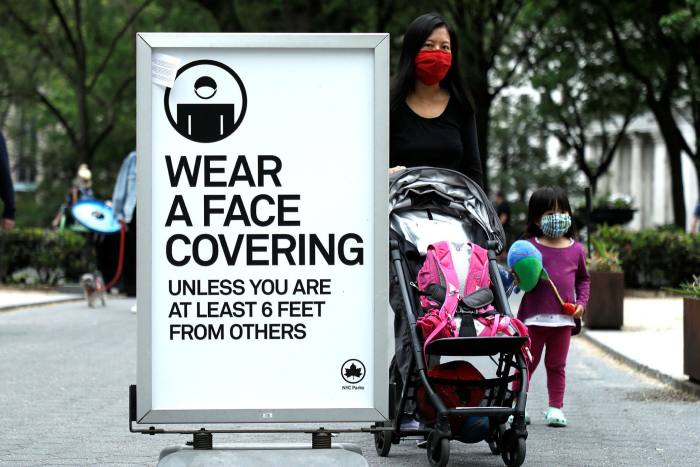
The pandemic has exposed the stretched just-in-time provide chains of companies that experimented with to reduce slack altogether. Prof Martin hopes it will prompt those performance-pushed leaders to say: “It ain’t operating, I have received to do some thing different.”
As for political change, the Martin Institute challenge showed that folks responded far more to difficulties that have been “really regional, that [they] can get [their] hands around”, somewhat than the dysfunction of federal politics. That is why Prof Martin places far more religion in bottom-up reforms, supported by citizens at state, municipal or faculty board amount — modest techniques, all over again, somewhat than big leaps. “I guess that is why I create things,” he says. “I hope that there will be some folks who will say, ‘Oh, yeah, I did not consider that into account. And if I do, then it’s possible I’ll tweak the following determination I make in a different way’.”
A change agenda for executives
-
Reject reductionism. Halt dealing with the business enterprise as a device and embrace the fact that it is a elaborate adaptive method of remarkably interdependent human processes. Around-optimise a person section and you risk alienating the folks who you have to have to be most engaged. Four Seasons Lodges and Resorts performs on the basic principle that it need to take care of its workforce as it wishes its workforce to take care of its company.
-
Recognise that slack is not the enemy. In the ideal quantities, slack contributes to larger resilience. Halt thinking of “no slack” as an achievable purpose. Suppliers these kinds of as Costco establish slack into their staffing to let workforce to provide more awareness to prospects.
-
Established various proxies for judging development. This avoids the danger of “surrogation”, where a single proxy turns into the target, undermining the progress in direction of the correct purpose. Southwest Airlines seeks to harmony the contradictory proxies of expense, customer fulfillment, worker fulfillment and profitability.
-
Realise that monopolisation is not a sustainable purpose. A terrific business desires terrific competitors to stay terrific. In the absence of competitors, monopolies do not have to pay attention to their prospects so they stultify above time. Longstanding companies these kinds of as ExxonMobil or Procter & Gamble have always experienced at the very least a person formidable competitor.
Tailored from When Much more Is Not Better, by Roger Martin


