
Executive education 2021: FT survey shows what employers want
Coronavirus disrupted deal with-to-deal with get hold of and forced providers to trim their charges, but it has also strengthened many employers’ determination to instruction for a broader assortment of their center and senior supervisors.
From a self-selective poll organised by the FT, more than a quarter of main finding out officers (CLOs) around the globe stated they intended to improve their budgets for executive training in 2021, when above 50 percent stated they would retain spending at 2020 stages. Just seventeen for every cent planned a reduction.
FT Govt Education directories 2021

Watch a listing of customised programme suppliers and open courses for supervisors in our directories. Examine the rest of our coverage on executive training at www.ft.com/execed and obtain out what the listings demonstrate.
The results arrive from a groundbreaking study carried out by the FT in partnership with Unicon, the international consortium for college-primarily based executive training, along with the Affiliation to Advance Collegiate Educational facilities of Business enterprise and the European Basis for Management Improvement — the two primary accreditation organizations — as perfectly as the Modern society for Human Useful resource Management.
Of the 363 respondents surveyed in February and early March 2021, the the vast majority labored for providers primarily based in the US and Canada, but Europe, Latin America, the Middle East and Africa had been also perfectly represented. Respondents labored in organisations of several sizes: more than two-fifths oversaw workforces of much less than one,000 men and women and more than a fifth had been dependable for instruction in teams with more than twenty,000 staff members. Respondents from finance, banking, health care and industrial businesses dominated.
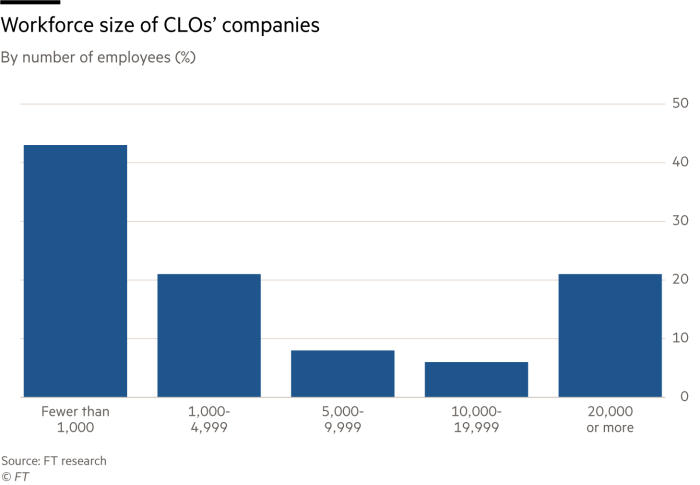
Extra than two-fifths of CLOs had been from providers with beneath one,000 staff members, with finance, banking, health care and industrial businesses dominating.
Prepared funds raises throughout 2021 had been greatest for providers in Latin America and Asia-Pacific, followed by the US and Canada, then the Middle East and Africa. People in Europe had been the least very likely to anticipate advancement in spending on instruction, but even so more predicted to improve than decrease expenditures this calendar year. General, the common expected improve was seventy three for every cent.
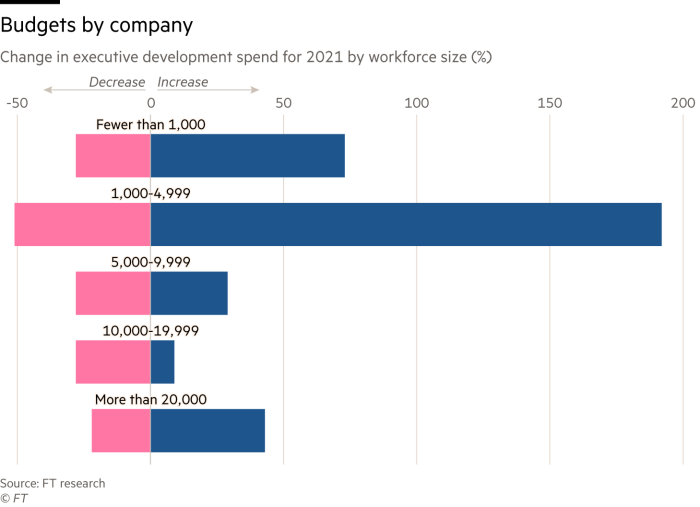
Corporations with one,000-4,999 staff members claimed the greatest expected alter in executive instruction expenditure for 2021.
Management was the top rated finding out precedence determined for executive training, cited as significant by eighty two for every cent of respondents. Improve administration followed, at fifty seven for every cent. Other longstanding priorities, together with digital transformation, strategy and innovation, had been also ranked highly by more than two-fifths of respondents. In a indication of the difficulties brought to the fore throughout the pandemic, the have to have for instruction around resilience, wellbeing and remote or on the internet collaboration had been also cited by many.
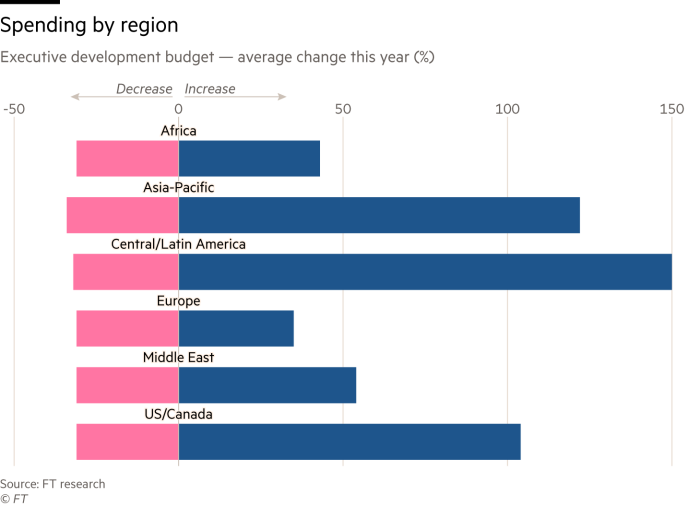
General, 83 for every cent of main finding out officers surveyed stated they planned to retain or improve their instruction budgets globally for 2021.
A further emerging theme — variety and inclusion — was a substantial precedence, cited by 55 for every cent, positioning it third general. Between US respondents, it was continue to higher — in next spot following leadership. That reflects the escalating concentrate on a matter that has mobilised senior managements in new months, induced partly by the killing of George Floyd previous May perhaps and the Black Lives Make a difference movement.
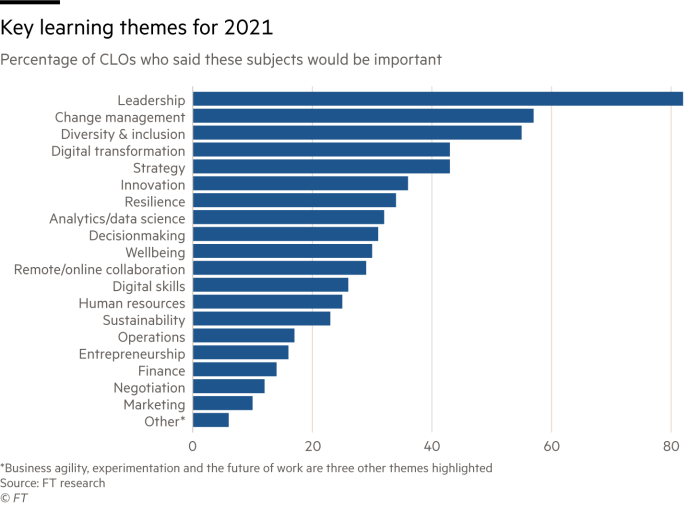
Management, alter administration, variety and inclusion and digital transformation are among the the top rated priorities to emerge in the pandemic.
Business enterprise universities can choose some comfort from the point that just above 50 percent of the CLOs surveyed stated they would switch to universities throughout 2021 for their executive finding out programmes. Having said that, a more substantial proportion pointed to solutions: more than two-thirds stated they would use interior methods and practically 3-quarters planned to use non-college instruction companions.
When CLOs had been requested to contemplate the most significant qualities of instruction organisations with which they would do the job, they judged study-primarily based and empirical know-how — 1 strength of small business universities — to be of small worth. They as an alternative placed the greatest emphasis on the value of customisation and an ability to exhibit return on financial investment. Cutting-edge know-how and a strong on the internet platform had been also highly rated.
“People want one thing that targets their have to have, rather than fascinating insights,” stated 1 CLO. “They want quick, sharp and partaking times of improvement (extended keynotes and time invested passively listening are OUT).” A further stated: “Virtual finding out has to be participative and to the position, with learners equipped to bring and do the job on authentic, recent troubles with defined, value-included takeaways.”
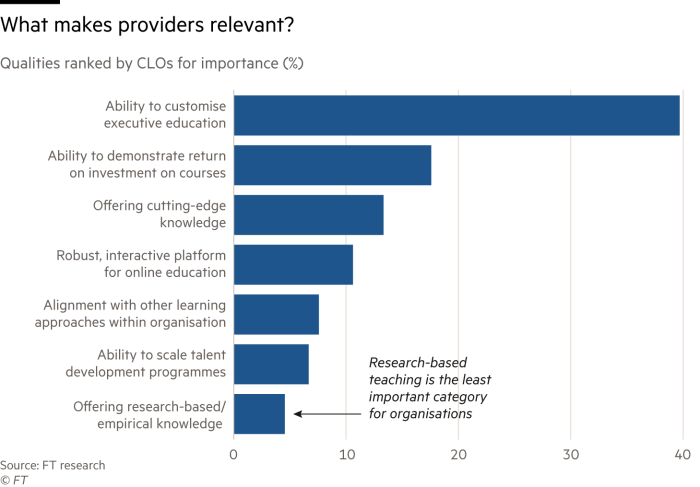
Customisation and return on financial investment had been rated higher than standard small business university strengths in study-primarily based and empirical know-how.
Several CLOs observed a development in the direction of exploring new and more efficient approaches to measure the value of instruction, with participants citing a change from annually to quarterly evaluations, conducting “360” assessments, and applying surveys prior to and following courses. They pressured the have to have for ever greater alignment concerning programmes made available and the strategic objectives of their organisation, and for “learning transfer” from participants to other staff members.
A person respondent talked about “actionable growth”. A further stated: “We will be seeking for challenge- or effectiveness-primarily based outcomes right tied to participation in executive training.” A third stated upcoming instruction programmes would be assessed to “more strictly measure and align with the ability to execute and employ a project”.
Chief finding out officers had been obvious that the hasty switch to on the internet finding out induced by Covid-19 lockdowns in 2020 experienced not been appealing, with the large the vast majority saying in-person finding out was much better. Having said that, they had been also real looking about the upcoming: most predicted a mix of physical and digital finding out would be the “new normal”.
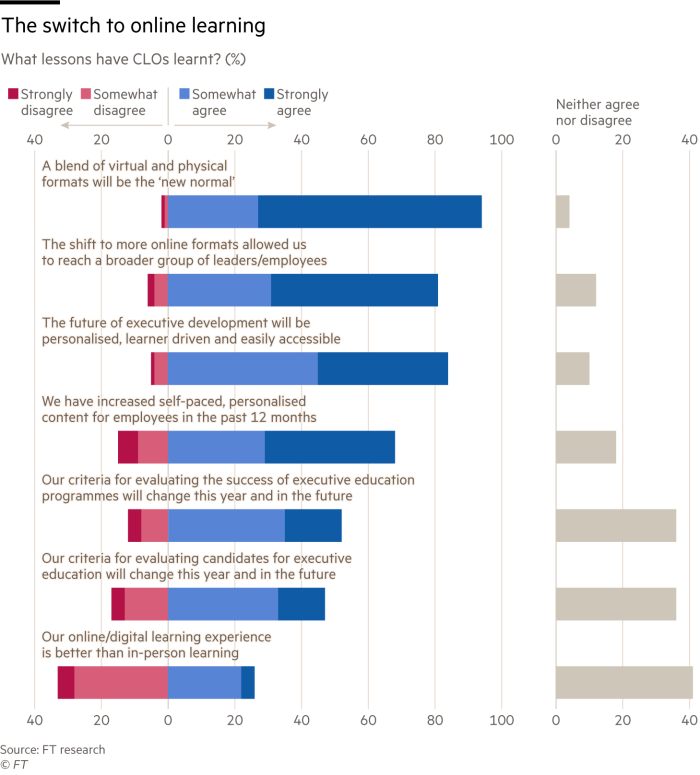
Last calendar year an enforced shift to on the internet finding out. Though CLOs like in-person educating, the change brought rewards such as elevated adaptability.
Extra positively, four-fifths agreed or strongly agreed that digital delivery experienced elevated adaptability and obtain to finding out, making it possible for providers to get to a broader group of leaders and staff members. These sights had been notably solid among the providers primarily based in Africa and the Middle East, and for more substantial businesses with workforces of twenty,000-moreover.
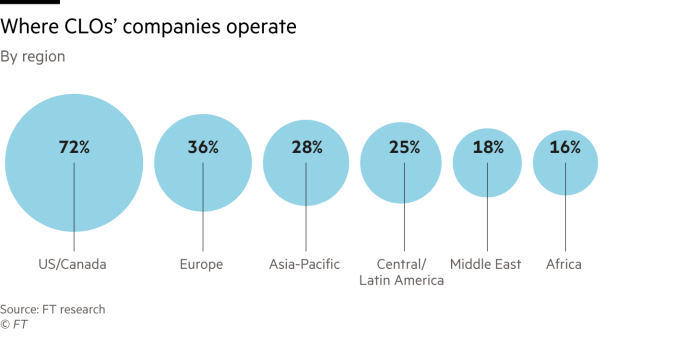
Approximately 3 quarters of surveyed main finding out officers’ providers operated in north America.
A number of CLOs stated they expected a renewed concentrate on executive training, to satisfy a soaring have to have for new competencies, succession scheduling and obtaining approaches to determine candidates for advertising. “We are shifting from seniority-primarily based to capability-primarily based,” stated 1. Other folks cited a different drive for increasing instruction that emerged throughout the pandemic: to inspire and retain key staff members.
Approximately two-fifths stated digital finding out experienced elevated the provision of self-paced and personalised articles. A number of cited the use of gamification and escalating curiosity in on-demand from customers instruction methods, “micro-learning” in smaller units and chunk-sized online video formats. Other respondents stated there was escalating demand from customers for co-operation and shared finding out with competitors and company universities, when 3-fifths stated evaluation and accreditation had been really or really significant in programmes.
General, sixty two for every cent of respondents expected new versions of collaboration around finding out, giving scope for innovation and intensified exercise by small business universities and other suppliers. But difficult negotiations lie in advance to give what CLOs seek out. As 1 stated: “[Just about] anything we have found is as well fluffy, lacks authentic globe articles and depth, and has provided nearly zero return on financial investment.”
Data by Sam Stephens graphics by Chris Campbell


